
real-time communications (RTC)
What is real-time communications (RTC)?
Real-time communications (RTC) is any mode of telecommunications in which all users can exchange information instantly or with negligible latency or transmission delays. In this context, the term real-time is synonymous with live.
In RTC, there is always a direct path between the source and the destination. Although the link might contain several intermediate nodes, the data goes from source to destination without being stored in between them. In contrast, asynchronous or time-shifting communications, such as email and voicemail, always involve some form of data storage between the source and the destination. In these cases, there is an anticipated delay between the transmission and receipt of the information.
Modes of real-time communications
Real-time communications can take place in half-duplex or full-duplex modes:
- Half-duplex RTC. Data transmission can happen in both directions on a single carrier or circuit but not at the same time.
- Full-duplex RTC. Data transmission can occur in both directions simultaneously on a single carrier or circuit.
RTC generally refers to peer-to-peer (P2P) communications, not broadcast or multicast.
The evolution of real-time communications
The development of the public switched telephone network in the early 1900s introduced RTC to the American masses, radically changing the nature of long-distance communication. In 1915, the debut of a new transcontinental telephone line meant that, for the first time in history, users separated by more than 3,000 miles could hold an interactive conversation as though they were in the same room.
Later in the 20th century, high-speed internet, mobile telephony and smart devices further revolutionized real-time communications, enabling instant messaging (IM), IP telephony, video calling, livestreaming, video conferencing and more.
This article is part of
Ultimate guide on enterprise unified communications strategy
Google's release of the open source WebRTC project in 2011 marked another major milestone for real-time communications technology. WebRTC uses JavaScript application programming interfaces to enable live, P2P audio and video communication within standard web browsers without the need for special plugins or standalone applications.
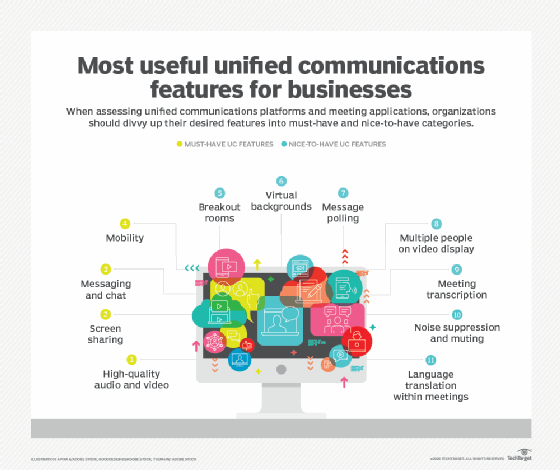
Recent advancements in WebRTC and cloud-based platforms have made it easier to integrate RTC into internet and mobile apps. The pervasive use of social media and video conferencing apps, such as Facebook, WhatsApp, Zoom and Skype, is a strong indicator of how important RTC has become in recent years.
The importance of real-time communications
Today's enterprise users expect to connect in real time from any location and device, making RTC a critical element of unified communications and collaboration (UCC).
The following are some of the key advantages of real-time communications:
- Flexibility. Team messaging platforms, file-sharing tools and video conferencing systems enable geographically distributed and mobile teams to engage virtually from almost anywhere, enabling a highly flexible workforce. Many businesses rely on IP-based real-time communications technology to minimize travel expenses, support remote employees and maximize team productivity.
- Remote collaboration. The COVID-19 global pandemic dramatically underscored the importance of modern RTC tools, which enabled many organizations to remain functional and productive even while accommodating unanticipated and potentially long-term work-from-home requirements. With live telecommunications and collaboration technology, enterprise users can accomplish shared tasks that they otherwise would have needed to tackle in person in a formal office setting.
- Instant interaction. RTC enables people and tools to communicate in real time, transcending geographical barriers and enabling instant conversations. This is crucial in scenarios where timely communication is essential, such as emergencies, customer support and teamwork.
- Enhanced personalization. RTC enables personalized and engaging communication, as it enables face-to-face interaction. For instance, an RTC platform, such as a live chat feature on a website or a video conferencing tool, can offer better personalization and increased client satisfaction as compared to an email.
- Increased productivity. Businesses that use RTC see a significant increase in productivity. Thanks to the rapid accessibility of answers and information, this increased productivity is felt across a variety of work situations, including on-site professionals, field workers and remote employees.
Real-time communications examples
Real-time communications tools and applications are many and varied, ranging from old-school telephony to cloud communications services.
Examples of real-time communication include the following:
- Fixed-line telephony.
- Mobile telephony.
- Voice over IP.
- Teleconferencing.
- Video calling.
- Video conferencing.
- File sharing.
- Screen sharing.
- Automatic, live meeting transcription.
- Team messaging (real time or near-real time).
- One-to-one IM (real time or near-real time).
- Live customer chat (real time or near-real time).
- Robotic telepresence.
- Two-way or multiway amateur radio.
Real-time communications vendors and products
Enterprise RTC providers run the gamut from major telecommunications carriers to small cloud startups. Real-time communications products and services in the UCC space include the following:
- 8x8 Work.
- Adobe Connect.
- Avaya Cloud Office by RingCentral.
- Webex by Cisco.
- Dialpad Ai Meetings.
- Google Meet and Voice.
- Lifesize.
- LogMeIn GoToConnect.
- Microsoft Teams.
- Mitel MiCloud.
- Pexip.
- Poly Studio X Series.
- Skype.
- Slack.
- Vonage.
- Zoom Meetings.
The future of RTC
Real-time communications is changing, and several trends are influencing how it will develop in the future. With evolving technology, new developments in the realm of real-time communications can be expected.
Regarding RTC's future, there are a few key points to remember:
- WebRTC is a significant development in the present and future of RTC as it enables real-time communications in Hypertext Markup Language 5 browsers without plugins.
- As mobile usage of real-time communications grows, concerns about network strain are rising, leading to a focus on scaling and enhancing security measures.
- Streaming media, such as Netflix and other over-the-top services, have become increasingly popular because they offer direct consumer services via the internet, while bypassing conventional distribution methods. Chatbots and virtual assistants will become more complex and personalized as a result of developments in artificial intelligence and natural language processing, enabling natural interactions with technology.
In the era of remote work, video conferencing stands out as a prevalent form of real-time communications. Explore five emerging trends in video conferencing and their transformative impact on remote and hybrid work setups.