Network layer

What is the network layer?
Located at Layer 3 of the Open Systems Interconnection (OSI) communications model, the primary function of the network layer is to move data into and through other networks. Network layer protocols accomplish this goal by packaging data with correct network address information, selecting the appropriate network routes and forwarding the packaged data up the stack to the transport layer (Layer 4).
Existing protocols that generally map to the OSI network layer include the IP portion of the Transmission Control Protocol/Internet Protocol (TCP/IP) model -- both IPv4 and IPv6 -- as well as NetWare Internetwork Packet Exchange/Sequenced Packet Exchange (IPX/SPX). Nearly all enterprise networks use the TCP/IP stack, as well as cellular data networks, including 3G, 4G LTE and most recently, 5G networks.
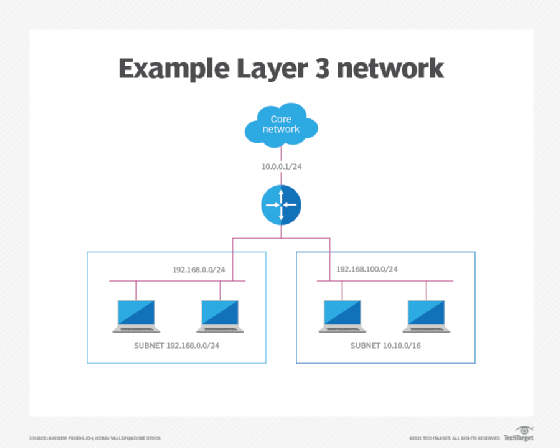
The routing information contained within a packet includes the source address of the sending host and the eventual destination host address of the remote host. This information is contained within the network layer header that encapsulates network frames at the data link layer (Layer 2). The key difference -- and importance -- between transport information contained at Layer 2 when compared to transport information contained at the network layer is that the information can move beyond the local network to reach hosts in remote network locations or different network segments. The following network topology diagram depicts devices in one IP subnet using Layer 3 routing to communicate with devices in a second IP subnet.
Functions of the network layer
The primary function of the network layer is to enable different networks to be interconnected. It does this by forwarding packets to network routers, which rely on algorithms to determine the best paths for the data to travel. These paths are known as "virtual circuits." The network layer relies on the Internet Control Message Protocol (ICMP) for error control handling and diagnostics to ensure packets are sent correctly. Quality of Service (QoS) is also available to permit certain traffic to be prioritized over other traffic. The network layer can support either connection-oriented or connectionless networks, but such a network data transmission can only be of one type and not both.
What is the OSI model and its 7 layers?
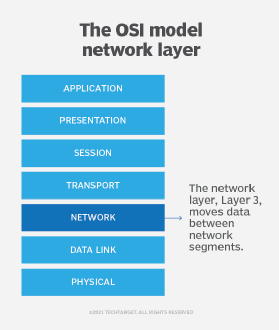
OSI is a communications reference model to help conceptualize how data can be transmitted and received on a network. The model consists of seven distinct layers forming a stack. Each layer in the stack is performed in a step-by-step manner: first, moving up the stack during data transmissions and then from the top of the stack down once the data reaches its destination. The layers of the OSI model, including the network layer, are shown below:
Protocols at the network layer
While IP is the most popular and widely used protocol at the network layer today, there are plenty of other protocol examples to note. Network protocols at Layer 3 include those used for dynamic routing of networks, secure communications, network translations and network redundancy. Here are a few examples:
- Open Shortest Path First (OSPF) is a dynamic routing protocol.
- Routing Information Protocol (RIP) is a dynamic routing protocol.
- Network Address Translation (NAT) translates and manages one IP address into another.
- Internet Protocol Security (IPsec) is a secure network protocol suite that uses authentication and data encryption.
- Hot Standby Router Protocol (HSRP) is a network path redundancy protocol.
- Virtual Router Redundancy Protocol (VRRP) is a network path redundancy protocol.